Flat Illustration of Vegetable Vector: A Fresh Design Asset
Understanding the Visual Appeal of Flat Design
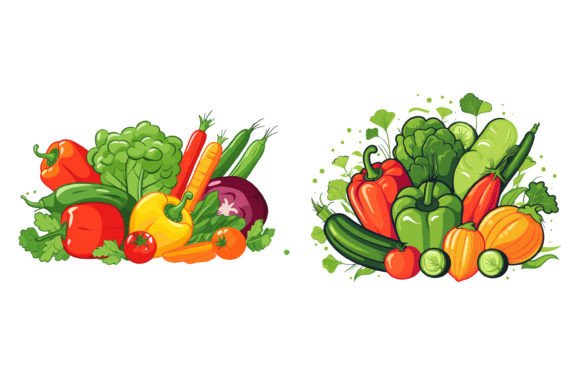
When you think about modern branding and digital content, the aesthetic often leans toward minimalism. The Flat Illustration of Vegetable Vector collection fits perfectly into this landscape. This isn't just a random assortment of clipart; it is a carefully curated set of vector icons designed to communicate freshness, health, and organic values without the clutter of realistic textures or complex shading. The visual style here relies on clean lines, bold shapes, and a distinct lack of gradients. This simplicity is its greatest strength. It allows the subject matter—vegetables like carrots, tomatoes, peppers, and leafy greens—to be instantly recognizable, even at very small sizes.
The personality of this style is friendly, approachable, and modern. It avoids the sterile feeling of some corporate icon sets while steering clear of the chaotic look of hand-drawn sketches. For a designer or a small business owner, this balance is crucial. You want your audience to feel a connection to the product, whether it is a farm-to-table restaurant menu or a health app interface. The Vegetable drawn vector icons set provides that immediate visual shorthand. It says "fresh" and "healthy" in a split second, which is exactly what you need in a fast-scrolling digital environment.
Practical Applications: From Screens to Print
One of the biggest challenges in design is asset versatility. You might find a great graphic for your website, but then realize it looks pixelated on a billboard or muddy on a printed flyer. Because the Flat Illustration of Vegetable Vector files are 100% vector-based, they solve this problem entirely. Vectors are mathematical equations, not fixed pixels. This means you can scale a single icon from the size of a favicon on a browser tab to the side of a delivery van without losing a single ounce of quality. This scalability makes them an essential part of any designer's toolkit.
Let's look at where these assets actually work best. The included file formats—typically EPS and JPEG—cover the two main bases of professional work. The EPS format is the powerhouse. It is fully editable in software like Adobe Illustrator. You can change the colors to match a specific brand palette, adjust line weights, or combine elements to create unique compositions. This is particularly useful for packaging design. Imagine a juice box or a bag of frozen peas; using these vectors allows you to create custom graphics that feel bespoke rather than stock.
On the digital side, the Flat Illustration of Vegetable Vector shines in mobile apps and web design. Flat design is the standard for user interfaces (UI) because it loads fast and is easy for the brain to process. These icons are perfect for nutrition tracking apps, grocery delivery service interfaces, or blog headers for food content creators. The clean edges ensure that the graphics remain crisp on high-resolution Retina displays and 4K screens. Furthermore, for social media graphics, where attention spans are short, a bold, flat vegetable icon can stop the scroll much more effectively than a busy photograph.
Enhancing Brand Identity and Visual Hierarchy
Typography and imagery must work in tandem to build a brand identity. While we often focus on font pairing—choosing a serif font for elegance or a sans serif font for clarity—the imagery anchors the message. The Flat Illustration of Vegetable Vector set acts as a visual glue for health-conscious brands. When used consistently across editorial design, such as cookbooks or wellness magazines, these icons create a rhythm on the page. They can break up long blocks of text, highlight key ingredients, or serve as bullet points that reinforce the topic.
Consider the impact on visual hierarchy. A plain text list of ingredients is functional but boring. Replacing those bullet points with matching vector vegetables instantly elevates the design. It draws the eye and makes the information easier to digest. This is a subtle psychological trick; when information is visually organized and adorned with relevant imagery, users perceive the content as more professional and trustworthy. For entrepreneurs and content creators, this perception of professionalism is vital for converting visitors into customers.
Selecting and Integrating the Right Style
Choosing the right assets involves more than just picking the prettiest picture. You need to evaluate how the Flat Illustration of Vegetable Vector interacts with your existing design language. If your brand uses a modern typography style with lots of whitespace and geometric shapes, these flat vectors will integrate seamlessly. However, if your brand is built on a handwritten font or a script font with a vintage, rustic vibe, you might need to edit the vectors slightly—perhaps softening the colors or adding a subtle texture overlay—to ensure they don't clash.
When testing these assets, always consider the context of the mobile apps or websites you are building. Check the "x-height" and visual weight of the icons against your text. Do they overpower the headlines? Do they look too weak next to a bold display font? Because the files are vectors, you have the freedom to tweak them. You might find that a specific vegetable icon works perfectly as a standalone hero image on a landing page, or perhaps it works better as a repeating pattern in the background of a presentation.
Finally, always respect the licensing. These assets are labeled as premium font and icon resources, meaning they are designed for commercial font and asset usage. This is a significant advantage for small business owners. You don't have to worry about attribution or legal gray areas when you put these vegetables on your product packaging or marketing materials. It provides peace of mind, allowing you to focus on the creative work.
Final Thoughts on Utility
The Flat Illustration of Vegetable Vector collection is more than just a set of pictures; it is a functional toolkit for visual communication. Whether you are a crafter making labels for homemade jams, a marketer designing a campaign for a new salad bar, or a developer building a grocery delivery interface, these assets provide the flexibility and quality required for professional results. They bridge the gap between complex photography and abstract iconography, offering a middle ground that is both informative and stylistically versatile. By leveraging the editable nature of the EPS files and the universal compatibility of JPEGs, you ensure your designs remain sharp, engaging, and on-brand across every platform.